Personal Profile

My photo
Jeddah, Western Region, Saudi Arabia
I was a reporter at the daily newspaper Saudi Gazette until 2008. Graduated from KAAU in Jeddah, with a BA in English literature... Satarted working at the Saudi Gazette February, 2007.. Entered the world of jornalism by chance and now I am trying different areas.

2008/04/26

Cancer seminar highlights survivals experiences

Thursday, 24 April 2008
By Kholood F. Al-Rhamah
Saudi Gazette

JEDDAH –
The King Faisal Specialist Hospital and Research Center (KFSH) held an educational symposium about cancer that highlighted the experiences of survivors of the disease.

KFSH’s Tumors and Spinal Cord Department held the event under the patronage of Princess Alia’a Bint Abdullah Bin Abdul Aziz at the Jeddah Hilton, on Monday.

The event was sponsored by Sanofi Aventis Company.
“We are about to hold a guidance program to help cancer patients and their families get through their ordeal,” said Princess Alia’a. “We aim to shed more light more on the personal experiences in the field.”
“It is very important to make periodical checks to discover the disease early,:” said Dr. Tareq Lingawi, Executive General Manager of KFSH.
“Discovering the disease early enough will give us the time and the possibility to cure it, or at least to try to find ways to contain it.”
The seminar focused on the fact that cancer can happen for anyone, with no regard to age or gender.
Two cancer survivors participated in the seminar. One of them talked about his own experience with the disease, and the other talked about his son’s ordeal.
“I don’t consider cancer a deadly disease,” said Ghazy Kayal, who managed to defeat cancer, laughing off the disease. “We only die when it is our time. (Death) is our destiny.”
“Early discovery of the disease is the most important thing to recover and live our lives,” he said.
“Also, strong faith in God is the best antidote for the patient’s emotions, so I just live my life and I don’t care about anything else,” Kayal added with a laugh.
Kamal Abdul Gader, a journalist, talked about his suffering with his two-year-old son’s affliction.
“You can only imagine the agony and the suffering his mother and I are going through,” he said. “The first advice I would give to any parent in my position is to avoid all marital problems and focus on one thing only: your child’s health.”
“The most difficult thing in my case,” he added, “was my emotional state. I was torn apart between him and my other two children. That’s why I placed my phone number at the children’s tumors department in KFSH, so any parent with the same condition can call me for help with the ordeal”.
He said that a parent with a child afflicted with cancer needs to have three things:“Patience, prayers, and giving money away for charity.”
Besides Lingawi, speakers at the seminar were Professor Ezz Eldien Ibrahim, head of the symposium and chief of the tumors department and the research center at KFSH, Dr. Abbas Zagnoon, who talked about alternative medicine, and Shiekh Hani Refaei, who talked about religious supplication.

2008/04/23

Hemaya targets 10 million addicts

By Kholood F. Al-Rhamah
Monday, 14 April 2008
Saudi Gazette

JEDDAH - In cooperation with the General Command of Dubai Police and the United Nations’ Regional Office in United Arab Emirates, Islamic preacher Amr Khaled launched his anti-drugs campaign, Hemaya, in an effort to combat drug addiction among more than 10 million addicts in the Arab World. The campaign concluded its events that went on for almost five weeks, taking place in many countries around the Arab World including Egypt, Saudi Arabia, Jordan, Kuwait, Morocco, Algeria, and United Arab Emirates.


Hemaya’s primary goal was to educate society members and draw in their participation in its activities, which aimed towards a drug-free generation. The five-week campaign concentrated on convincing those who are healthy to stay away from drugs and on encouraging addicts to seek treatment.


In an interview on Al Rabiya.net, Amr Khaled said that the goal of the program was to distribute one million posters bearing the campaign’s motto, “Stop drugs, Change your Life”, in youth gatherings like clubs, universities and schools.
“ Our second goal was to arrange five thousand events in Arab countries, in which youngsters would receive advice from their peers in concerts, Friday ceremonies, school seminars, marathons and religious seminars, in addition to media coverage and other activities with celebrities,” Khaled said.


“The first and second goals are means to achieve the third goal which is to get five thousand Arab addicts in treatment and rehabilitation programs, a process that will take from four to six months,” Khaled added. The campaign management set a communication center and e-mail addresses to communicate with and encourage those seeking treatment while guaranteeing the confidentiality of their personal information. Hospitals participated in the campaign by offering 50 percent discounts on rehabilitation programs, according to Al Rabiya.net.


The campaign’s modest budget was raised by society members that responded to the call of Amr Khaled in addition to media and charitable organizations like Life Makers, while many volunteered to work in rehabilitation centers. The program of the campaign also focused on helping inmates in correctional facilities overcome their addiction on drugs.According to Al-Arabiyah.net, The United Nation’s anti-drug office’s sponsorship and participation was due to the office’s confidence in the wide popularity and influence of Amr Khaled among youngsters, which will probably play a cardinal role in convincing those on drugs to seek treatment.


Rana Al-Morabet is one of many volunteers from Life Makers, Jeddah, a charitable organization that took on most of the workload in the campaign.


“Life Makers was built on the concepts and ideas of Amr Khaled, so whenever he thinks of something we start executing immediately,” Says Al-Morabet, “400,000 brochures were distributed in malls in the first week, along with 10,000 bookmarkers, 10,000 stickers and 10,000 brooches. T-shirts bearing the campaign’s logo were distributed among cleaners in streets, since they are usually very susceptible to addiction”.

2008/04/22

Relic town to get modern services

Tuesday, 22 April 2008
By Kholood F. Al-Rhamah
Saudi Gazette

The ancient ruins of the town of Alghat are about to spring back to life.

Thanks to the Saudi Ministry of Water and Electricity, ancient history and archeology buffs would have two more reasons to go and appreciate the town’s rich history: running water and places for comfort.

The ministry has signed two contracts with a private company to connect the ancient town, outside Riyadh, with water and sewer systems.

The first contract, worth SR2.2 million, will provide the town with fresh water.

The other contract will begin with laying a main sewer line, at a cost of SR3.8 million.

Abdul-Ilah Aal Al-Sheikh, executive manager or the Tourism Development Department in Riyadh, said the rehabilitation of Alghat is part of a broader program to revamp ancient ruin towns in the Kingdom, which is being conducted by the Supreme Commission for Tourism, in cooperation with various other government agencies.

“The program aims to develop the old towns in the Kingdom economically and culturally, in a way that preserves their real identities and makes them a source of revenue for the local residents, along with providing job opportunities,” Aal Al-Sheikh told the Saudi Gazette.

The program also aims to boost tourism and jump-start services in these areas, like hotels, rented apartments, restaurants and transportation.

It would also contribute to give locals a reason to stay in their villages in order to maintain a developmental balance.

The SCT is executing the program in cooperation with the Ministries of Interior, Social Affairs, Transportation, Water and Electricity, Agriculture, Islamic Affairs, Endowments and the Call, Municipal and Rural Affairs, the Information Technology Commission, a number of private companies and local communities in various regions.

2007 Summer festivals provided 4,000 jobs

FRONT PAGE
Tuesday, 22 April 2008
By Kholood F. Al-Rhamah
Saudi Gazette

JEDDAH – Tourism activities during 2007 garnered more than SR1.3 billion in profits and provided more than 4,000 permanent and temporary job opportunities, according to a report by the Supreme Commission for Tourism.

The report said more than five million people attended 33 festivals and more than 175 other activities in 2007, a growth of a whopping 600 percent compared to 2005.

“The events sponsored by the commission had accomplished many economic and social benefits where they were held,” said Hamad Al-Sheikh, general manager of tourism products and programs at SCT. “Many new themes had been developed, like motor sport and folk shops.” “We aimed to give tourists new sites to visit by holding many events in all seasons, like Eid or the mid-year vacation, in addition to weekends and not only in the summer.”

The private sector made its own contributions in organizing the events, adding quality and economic growth, he added. “We also have partners who helped us create new events for the first time in the Kingdom, such as the Hail Rally, Obhur Tourism Festival, spring vacation festivals, Jizan Winter Tourism Festival, and the Olive Festival in Al-Jauf,” said Sheikh.
“Tourism festivals are good opportunities for Saudis to find jobs, especially with an increasing number of activities.”

2008/04/18

Environmental forum to tackle urban waste

Friday, 18 April 2008
By Kholood F. Al-Rhamah
and Adel Al-Malki
Saudi Gazette

JEDDAH –
Experts in meteorology and the environment are expected to present practical solutions for waste handling in large cities at the First Jeddah Environmental Forum.

The forum is scheduled to begin on Monday through Wednesday, under the patronage of Crown Prince Sultan Bin Abdul Aziz, Deputy Premier, Minister of Defense and Aviation and Inspector General.

It is organized by the Jeddah Chamber of Commerce and Industry and supervised by the Saudi Meteorology and Environmental Protection Authority (MEPA.)More than 30 international experts will participate in the forum, headed by Dr. Farouk Al-Baz, a leading Arab-American scientist who was involved with the Apolo lunar landing program.

“The forum will focus on the main issues, such as sustainable development and water and air pollution,” Dr. Mohamed Al-Jehani, head of the First Jeddah Environmental Forum said.
“The recommendations will be prepared by a number of experts and specialists who will focus on finding solutions to water shortage problems in the whole world.”

“More than 50 million people can’t have fresh water on a daily basis,” he added. “Some people expect that the next great war will be over water.”He said that urban waste is considered a very serious issue in many countries, especially in the Middle East.

“Garbage depends on personal behavior first, because it’s part of everyone’s daily life,” said Jehani. “The real suffering comes from the health problems that arise because of the accumulation of garbage spread in random areas in developing countries.”

He added that one of the ways waste disposal can be controlled is by monitoring disposal methods of businesses and keeping it in check before it becomes life threatening.

“Incineration is a method known to be safe, provided that it’s done outside city limits,” said Jehani, “so that the resulting smoke wouldn’t affect the respiratory systems of humans and cause allergies.”

To dispose of garbage in a healthy way, he added, “there has to be a location designed specifically to handle garbage.”

“Such a facility should be able to accommodate garbage trucks, and calculate the amount of trash in each of them and what district they came from. It should also have a filtering system to dispose of the gas that results from incineration, so that chances for pollution are minimized.”

Garbage Fires and water pollution from sewers, polluted rain water, industrial waste and insects pesticides are the main reasons of pollution in Jeddah, he added.

KFSH to hold surgery conference

Friday, 18 April 2008
By Kholood F. Al-Rhamah
Saudi Gazette

JEDDAH –
King Faisal Specialist Hospital and Research Center is scheduled to hold the First International Surgery Conference on 11-14 May at the Jeddah InterContinental hotel.

The conference will discuss stethoscopic surgery and general surgery science. Various lectures by many researchers and surgical professors from all over the world are planned.

“The conference will discuss topics like tumor surgery, breast diseases, digestive diseases, and taking care of wounds in diabetics, to name a few,” said Dr. Osman A. Hammour, consultant general and laparoscopic surgeon at KFSH.

“The conference will host speakers Prof. Sir Kadshiery from England, Prof. Peterpetsia from Italy and Dr. Mohammed Ali Al-Bar, an internal consultant from Saudi Arabia.”

The conference will also organize many workshops specialized in helping trainee doctors and teach them how to prepare for a surgery test and ways to answer the questions of patients and their families.

2008/04/16

STC moves on SMS spam


Tuesday, 15 April 2008

By Kholood F. Al-Rhamah
Saudi Gazette


JEDDAH – Unwanted SMS messages millions of people in Saudi Arabia receive on their mobile phones are about to be a thing of the past.SMS spam, which is the GSM version of spam email, has been an inconvenient aspect of the convenience of mobile phones for many people.


Internet websites from which these messages are spewed by the billions onto people’s handsets will be no more, after the shutting down of many of these websites. Countless websites buy SMS services from GSM providers, while the latter opens access to the concerned sites, letting people spam others with SMS messages that could contain just about anything, from love letters to sales promotions to nuggets of Islamic knowledge.Most of the time, those on the receiving end of the daily avalanche of spam never know who it is that is clogging their phone memory chips.“These websites are causing so much trouble for us,” said a source at Saudi Telecom (STC), who wished to remain anonymous.


“We have complained to the Communications and Information Technology Commission (CITC) and asked them to shut down these websites, because they are the main sources of spam SMS,” “The service is misused by some of the service providers, and after many of our subscribers complained about it, we asserted that it had to be stopped.”He added that SMS messages, as well as some of these websites, can be used to defraud mobile users. The simplest scam is to have someone else pay your phone bill, thinking that he’s paying his own.“In one of the scams, a subscriber received a notification SMS – ostensibly from Aljawal, but with no sender’s number – telling him his bill had been issued,” said the source.


“Usually such messages (sent by Aljawal) contain the account number of your mobile, so you can enter it into any ATM machine to pay the bill. When the unsuspecting subscriber, however, entered the account number in the message, it turned out that he had just paid someone else’s bill.”The STC itself is only responsible for a specific type of messages, called Cell Broadcast Services (CBS.) These are short messages sent to subscribers announcing new services, in cooperation with government authorities and charitable organizations. There are also targeted messages, like the ones about a campaign to help kidney failure patients and antidrug campaigns.“In order for a company to buy a specific number for SMS service from STC, they have to meet certain conditions,” said the source.


“The numbers in their database have to be approved by the subscribers to whom they will send the messages, they should not send spam messages, they are not allowed to send any international messages, the content of the messages should be suitable with respect to traditions, and they should not damage the reputation of any other rival company.”He said STC retains the right to terminate the use of SMS services by any company if it received complaints from any subscriber about spam messages they had sent. The companies that send these messages are hardly short of resources to build their phone number databases. The main source, however are the subscribers themselves.


“Whenever a subscriber buys something at a shopping mall, for instance, he or she may participate in a contest,” said the source. “They fill coupons with their names and mobile numbers. After the contest is over, some companies buy the boxes in which the coupons are dropped, and fill their database with people’s personal information, including their age, sex and, of course, mobile number.”He urged subscribers not to give out their phone numbers to people they don’t know or provide that information in competitions or similar activities.Itihad Itisalat (Mobily), the second telecommunications company operating in Saudi Arabia, has its own way of dealing with spam messages.


“The percentage of spam messages our subscribers get is very low - and almost nothing compared to other networks, in fact – because our system has devices that prevent them,” said Humoud Al Ghobaini, Mobily’s spokesman and head of corporate communications. “The only messages our users receive are the ones we send to them announcing new services, and we never send more than two or three a month to each subscriber.”

SMS spam: No opt-out

Tuesday, 15 April 2008
By
Jassim Alghamdi and
Kholood F. Al-Rhamah
Saudi Gazette

JEDDAH –
There are literally millions of people who will say that spam SMS messages are a problem.Perhaps predictably, mobile phone users will say that they clog the memories of their mobile phones, and that they are annoying because subscribers receive several of them a day. They will probably also say that they are just a waste of time and money.

The real problem, however, is that as of yet, subscribers simply can’t choose not to receive them.For some mobile users in Saudi Arabia, the problem is even worse than that of email spam, because unlike an email client or web-based email service, there is no way to block unwanted messages and senders in mobile phone settings.

In an attempt to find out if there is any possibility to avoid receiving these messages, the Saudi Gazette called the costomer service number of a mobile service provider in the Kingdom. The answer was no.When the customer service operator was asked how to avoid receiving these messages, he said that “these are normal advertisement messages and you cannot avoid them.”
That operator said he had written a complaint to his superiors about these messages, saying that he had been getting so many calls about them from subscribers.

They promised to review the complaint in 48 hours and see what they can do about it.
The operator said he had no way of blocking these messages from being sent to any specific user.When asked how the senders could’ve obtained the phone number, he replied: “maybe when you bought something from a company, you gave them your number.”

The manager in a well-known company in Jeddah, who asked for himself and his company not to be named, said his company only sends messages to its own customers.

“We never send any ad messages to anybody but our own costomers or the ones recommended by them,” he said.

When asked about the high frequency of messages costomers are receiving from them, he blamed the service provider.

“The problem is with the mobile service company,” he said.
“For example, when a subscriber’s phone is turned off, the system tries to send him or her the message several times till he or she turns on the phone. Then all those messages will arrive in quick succession.”Some people want an immediate solution for the problem.

“I receive (mobile SMS spam) everyday, and this has become truly a headache,” said Mish’al Al-Sharif. “I couldn’t find a way to stop receiving it. I heard that if this happens in a Western country, I could sue both the sender and the service provider.”

Ahmed Al-Qahtani, a high-school English teacher, probably speaks for millions when he says he’s fed up with useless spam messages that clog his mobile phone’s memory.

“I’ve had enough of those messages,” he irately told the Saudi Gazette, “so much so that I don’t even bother to pick up the phone anymore when I hear the SMS tune.”

He said spam SMS is especially annoying when sent late at night.“You would think that there is something important, but it is just an advertising message.”

“Unfortunately, there is no law in Saudi Arabia that would allow you to sue the companies that are using your personal number for commercial purposes,” said Abdul Samad Al-Mahdali, a Saudi lawyer.

“Before you file a lawsuit, however, you have to remember if you have chosen your number to be shown to the public when you subscribed with the provider or not,” he cautioned, “because if you did, the companies can argue that you wanted your number to be known, which could blow your whole case.”Some women, on the other hand, actually want to get spam SMS, seeing it as a way to find out about events they would like to attend or discounts at shopping malls.

“It is annoying sometimes, but I loved some of the things they said, like hotel discounts in vacations and a sale in my favorite shop,” said Fatmah Al-Harthy, a housewife. “It is better than missing the opportunity.”

Cancer survivors speak at symposium

Tuesday, 15 April 2008
By Kholood F. Al-Rhamah
Saudi Gazette


JEDDAH – King Faisal Specialist Hospital and Research Center (KFSH) is holding an educational symposium about all kinds of cancer.

The symposium will be held under the sponsorship of Princess Alia’a Bint Abdullah Bin Abdul Aziz on the April 22 at Jeddah Hilton Hotel’s Al-Qasser hall.

The symposium aims to promote the latest advancements in the treatment of cancer. “Cancer has no respect for age or gender,” said Professor Ezz Eldien Ibrahim, head of the symposium and chief of the tumors department and the research center at KFSH. “It has been known since 1,500 BC, and its mystery resembles that of life.”

“The goal of the symposium is to educate, not intimidate,” added Ibrahim. “It is better for people to protect themselves than not knowing the disease that can kill them from within.” He added that one major issue is that patients do not fear the disease itself as much as they fear the treatment.

“They should face it by doing periodical checks that can help them to avoid it, or at least to discover it in its early stages, so that chances for healing would be higher than they would be if the disease were discovered in later stages,” he said.

Two physicians will be speaking about alternative medicine and religious supplication at the symposium. Two patients who survived from cancer will also talk about their personal experiences in fighting the disease. There will also be an open discussion that Ibrahim will run.

MoE mulls TV channel

Monday, 14 April 2008
By Kholood F. Al-Rhamah,
Saudi Gazette

The Ministry of Education is studying the prospects of opening an educational TV channel.The Students’ Activities Committee at the ministry proposed the project.

If opened, the TV channel will cover all the activities of the committee, such as summer clubs, plays, educational contests, and training programs in various areas all over the Kingdom.

It will also promote the committee’s role in helping students invest their time in useful activities. “We have been studying the project for three months,” said Dr. Nasser Al-Qarny, Head of the Students’ Activities Committee at the Ministry of Education. “(We are) doing research, talking to experts, and taking advantage of the experience of other channels.”

He added that until now, it is still merely an idea, but “we are hoping it will be executed soon.”“The majority of the Saudi population is young, and our community is targeted by many disreputable TV channels that try to poison their thoughts and actions,” he said. “Our duty as an educational establishment is to take advantage of TV technology in correcting their ideas and guiding them.”

The other educational channels currently running have no relation with the MoE and do not work according to its guidelines. “Our goal is only educational,” he pointed out. “There will be no financial profit. This channel will be working under the authority of the MoE and monitored for any unauthorized content in the programs.”The educational policy in Saudi Arabia focuses on the role of the media and its power in solving the problems of young Saudis, he said.

“Our students’ activities are more than enough to supply content for not one TV channel, but many,” he said, “because we have many activities and they are fun and useful to everyone.”
“It will also give parents more insight about what is happening in summer camps, for example, to make them feel more secure about sending their children there.”

2008/04/14

SCT holds training course

By Kholood F. Al-Rhamah
Monday, 14 April 2008
Saudi Gazette

JEDDAH – The Supreme Commission for Tourism (SCT) held a training course on Tourism Guidance Skills in Jeddah recently.The first of its kind in Saudi Arabia, the five-day course focused on various issues concerning the work of tourist guides.
The course also covered topics that directly relate to the profession of tourist guidance, such as how to handle and use research tools, developing communication techniques, and practical aspects of guiding a tour, such as making transportation arrangements and scheduling museum visits, among other things.Dr. Abdul Aziz Al-Haza’a, engineer Abdurrahman Al-Rakban and Dawood Al-Wadi, the trainers who gave the course, are internationally accredited tourist guides.
Rakban told the Saudi Gazette that there were 21 trainees in the course. “After the success of the first course, we are planning to have many more, at least two or three courses covering all the Kingdom’s areas,” said Rakban, who is the manager of the tourism guidance project at the SCT. He added that the course was compatible with international standards.
“These standards are important in showing tourist guides the basic skills needed for their careers and teaching them how to best entertain tourists,” said Rakban.
The SCT is promoting the profession for all Saudis, and spreads the word that those who desire to become tourist guides should come forward and apply.Also, they can visit the tourist guide website Prince Sultan Bin Salman, the Secretary General of the SCT, had inaugurated recently.
The link to the website is www.Sauditg.org.

2008/04/13

Saudi reporter had no time for thrills on edge-of-space flight


FRONT PAGE
Sunday, 13 April 2008
By Kholood F. Al-Rhamah

JEDDAH –
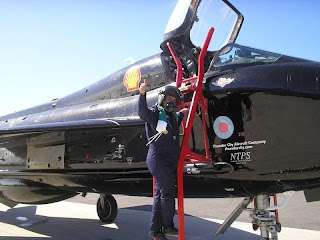
Three Saudis, including one TV reporter, have successfully completed a trip to the edge of space last Monday.

Saeed Al-Jaber, a Saudi TV reporter for Orbit TV, and two other Saudis, Ibrahim Al-Fadli and Mohammed Al-Najjar, were passengers on two vintage Lightning fighter jets that have vertical takeoff capability.

Sponsored by Arab satellite TV Company Orbit and bankrolled by American Express, the trips were launched at Thunder City, the world’s largest privately owned collection of military aircraft, near Cape Town, South Africa.

The trip started at 10:00 AM on Monday and lasted for an hour. Reaching the planned altitude took a good 50 minutes, while the descent back to the ground took a mere 10 minutes.
The Lightnings displayed their remarkable capabilities by carrying the crew off the runway and rapidly into vertical takeoff, and through the sound barrier soon after.

“I’m so proud to have represented the Saudi media,” Jaber told the Saudi Gazette after the trip. “I’m also honored that Orbit nominated me to cover the story, which encouraged me to give it my best effort.”He also dedicated his success to Saudi Arabia and its people.
“I dedicate this success to all Saudis, starting with the Custodian of the Two Holy Mosques King Abdullah Bin Abdul Aziz, Crown Prince Sultan Bin Abdul Aziz, my father, my mother and everyone who supported me during the trip,” said a jubilant Jaber.

He added that the idea of being part of the trip came after Fadli and Najjar won their places on the trip in a contest in Saudi Arabia. Orbit, the sponsoring company, nominated him to cover the story.
Jaber said the preparations for the trip were no less exciting than the trip itself. Several events and adventures were scheduled to groom the crew for the physically grueling flight.

“The preparations took six days, included flying from Riyadh to Cape Town through Dubai then Johannesburg,” he said, adding that he and the rest of the crew received extensive training on simulators of the renowned Lightning jets at the private airfield.

“The training included drills on using safety and escape equipment onboard the fighters and how to perform an emergency exit in case of an accident,” he said.

“We were also trained on how to use a parachute to land safely back to Erath.”They were also trained on communicating with the pilots, using auxiliary oxygen supplies, coping with a confined cockpit, proper seating position, and controlling the body to withstand the enormous G-forces experienced in such extreme flights.

“The G-forces can crush your body if you didn’t sit up straight all of the time,” he quipped.“The plane made all sorts of moves in the upper stratosphere, near the area between the earth’s atmosphere and space,” Jaber said. “We could see the daylight turning into dark. We could see the curvature of the earth while our cameras rolled, taking pictures and footage of both space and the plane’s cockpit.”

Jaber says that so far, the endeavor is the high point of his career, but he wouldn’t let his own excitement get the better of his journalistic integrity and objectivity.

“Covering the trip was all what I cared about,” he said. “That said, it was important for my integrity as a journalist to convey the details as they happened. I had to focus more on taking care of the camera, the cameraman and my reporting than enjoying the trip. My responsibility was much greater than thinking about enjoying myself.”

It was the first flight in history in which the Saudi flag has been raised that high.“The fact that a Saudi camera with a Saudi journalist reached so high up for the first time made me full of pride and joy, because I was the one who represented the Saudi media in the trip,” he said.

“It made me realize that we, as media representatives, should give the Saudi media our all.”Orbit will broadcast footage of the flight in episodes later this year. The company would not give an exact time of when the program would be aired, but only said the program will run in five episodes as soon as the editing is done. The network added that it will be aired from a Monday through the following Thursday.

Just like Jaber, Fadli and Najjar were thrilled to have been part of such a once-in-a-lifetime experience, especially that being unburdened with camera equipment and the responsibility of reporting, they probably enjoyed themselves more than Jaber.

“It is a wonderful adventure,” Fadli said after he flew back to the Kingdom. “With so much waiting to be explored and experienced, all of us should have countless reasons to stay away from terrorism and destruction and live in peace and make the world a safer place.”

Lightning fighter-interceptor jets, made by British manufacturer English Electric, later incorporated into the British Aircraft Corporation (BAC), during the Cold War years, had served in the Saudi Royal Air force for 25 years before they were decommissioned and sold to Mike Beachy Head, the South African businessman and pilot who built Thunder City.

Prince Major Turki Bin Abdullah Bin Abdul Aziz, a seasoned pilot, flew the plane himself four weeks ahead of the trip at Thunder City.

2008/04/06

Conference focuses on nutritional aspect of everyday health

Sunday, 06 April 2008
By Kholood F. Al-Rhamah

JEDDAH –
The importance of nutrition in preserving everyday health for adults and children was the focus of a three-day conference King Faisal Specialist Hospital organized late last week.

The conference highlighted the importance of nutrition preventing diseases that have become more common in the busy everyday life of people in an ever faster-paced society.

“We are aiming in this conference at various categories with different messages to ordinary people, doctors and nutritionists,” said Dr. Saddah Eshki, Chief Clinical Services, Chairman Medical Nutrition Department in KFSH and the conference chief. “We explained Cardiology diseases in particular to the public, because these are high mortality diseases.”

He said the conference gave the message that excessive use of some medicines could cause more problems than they can cure, such as cholesterol drugs, which can cause cancer and liver problems if they are taken more often than they should be.

“The second message is for doctors to focus on the importance of medical nutrition for patients,” he said. “If the patient was in intensive care with wounds, the healing process could go better if there was better nutrition.”

He said cancer patients can be treated without putting them on bad diet that could worsen their cases and eventually kill them.

“The third message is for nutritionists, who should constantly update their knowledge after graduation,” said Eshki.

He added that it was a very good step for King Abdul Aziz University to open a specialty in medical nutrition.

Many speakers from different parts of the world participated in the event, such as Dr. Allan Johnson, associate dean of the division of Allied Health Sciences at the College of Pharmacy in Howard University, and Dr. Federico Bozzetti, Oncologist Surgeon and the head of the surgical department at the Hospital of Prato, Italy and Dr. Lubso Sobotka, Professor of Medicine, head of the Department of Metabolic Care and Gerontology, Medical Faculty in Charles University, Czech Republic.

“Cachexia, loss of weight, muscle atrophy, fatigue, weakness and significant loss of appetite in someone who is not actively trying to lose weight, is a major cause of mortality among cancer patients, because from 10 to 25 percent of cancer patients with advanced disease die because of it, not because of the affliction itself,” said Bozzetti.

“It is quite important to approach this kind of patient from the nutritional point of view.”He added that “the preparation and the cultural background of nurses and dieticians (in Saudi Arabia) impressed me very much.” “It is different, higher and much better than many other countries in Europe,” Bozzetti said.

2008/04/05

3 Saudis on trip to edge of space


Saturday, 05 April 2008
By: Kholood F. Al-Rhamah, Saudi Gazette


JEDDAH – For the first time in history, three Saudis, including a reporter, will fly on a trip to the edge of space.

Saeed Al-Jaber, a reporter, left Riyadh on Friday for Cape Town, South Africa, to prepare for the trip, which he will be covering for satellite network Orbit Television and Radio.

“This trip is the ultimate chance for any reporter,” said Al-Jaber. “It only comes once in a life time. I am so proud and happy to be the one who got that chance, and I’ll do my best to convey the facts as I see them on the trip.”


He said the whole experience will be documented and recorded in order to be broadcasted on Orbit Television and Radio through a series of reports after he comes back.


There will be extensive training for the crew that will participate in the trip, which will include two other Saudis.


The participants will be flying on a special aircraft that can take off vertically and accelerate all the way to the edge between the Earth’s atmosphere and outer space, which is believed to be 100 kilometers high.


“After the preparations of the trip with the rest of the crew, we will go to the edge of space,” said Al-Jaber.

“The Saudi media is going through one of the most challenging tests of its integrity and credibility, and I am proud to be the one who’s conveying it and conquering all my fears.”

Al-Jaber said he always had a dream to leave his mark by proving the capabilities of Saudi reporters in conveying facts as they happen and go through difficulties to get to them. He said he was getting great support from his family and friends.

“When I told my father, he said this experience is so unique that it eclipses getting a PhD,” he said. “He always wanted me to pursue higher education.”

“As for my mother, she wished me good luck with her continuous prayers and asked me to keep the Holy Qur’an with me at all times.”

Al-Jaber had studied chemical engineering at King Saud University (KSU) in Riyadh. He joined Orbit’s Riyadh office in December 2005 as a reporter.

Before that, he worked in public relations for seven years, including reporting on the Kingdom for France24 TV in Arabic, Elaph.com and Al-Mustaqbal newspaper. He also did gigs as a PR consultant and statistics supervisor with the Supreme Commission of Tourism.

The one-hour flight will launch from the biggest military aviation base in Cape Town, South Africa.

2008/04/03

First Health Economics symposium held

Tuesday, 01 April 2008
By Kholood F. Al-Rhamah

JEDDAH –
For the first time in Saudi Arabia, the King Faisal Specialist Hospital held a symposium discussing health economics on Saturday and Sunday.The symposium was held in cooperation with Roche Company at the Jeddah Intercontinental Hotel.

Leaders in health care, hospital executives, doctors, and health insurance specialists attended the conference.

Abdullatif Abdullah Al-Nugali, executive officer of administrative affairs at the hospital and chairman of the organizing committee, said that health economics is a new topic for the Arab world.

“The branch of health economics focuses on finding the real cost of health services in an accurate and organized way, and consequently helps decision makers to make the right decisions,” said Nugali.

The conference also focused on the best ways toward presenting the best health services at the least costs.

“The conference aims to discuss methods to evaluate decisions related to health sources and presenting different choices for patients,” said Azza Raslan, chief of the internal review department and financial consultant at the King Faisal Specialist Hospital.

“One example is using a new medicine and evaluating its effect on patients and whether the cost of treatment will rise or drop,” she said.

She added that the conference is aimed more at health care establishments than individuals.“The patients are certain to get the treatment they need, but what we want to discuss is the way they are getting, which we call treatment management,” she explained. “That includes deciding whether we should use the medicine first with the patient and how we manage his treatment.”
The two-day conference hosted many world-renowned speakers, such as Denzyl H. Cain of South Africa, head of funding, health economics and pricing at Roche, and Ahemd Samir Zazaa, pharmaco-economics manager at the same company.

“It’s been an excellent experience so far, it is quite a new topic for health care institutions in Saudi Arabia,” said Cain. “Health economics is all about how we can use healthcare resources more effectively and that we have improvements in terms of budget.”

“We also discussed more subtopics that have to do with budgeting, like cost effectiveness analysis and cost utility analysis, considered tools that hospitals and their administrators can use to make better decisions.”

He added that “there is a lot of money available in the system and there is an excellent level of health care, but Saudi Arabia faces the same problem as every other country, and that is the rapidly rising cost of medicine.”

“[The cost of medication] is always rising and changeable,” he said, “so the decision makers are increasingly faced with the issue of how to make rational decisions in the best interest of the patient while maintaining efficient use of their resources.”

Zazaa said he saw in the conference an opportunity to make an initiative to introduce health economics into the Kingdom.

“The door is wide open to enhance and improve the quality of health care in the Kingdom,” said Zazaa. “It is important for both the patient and the hospital, because more patients will have access to health care services.”

American statistics show that by 2050, 20 percent of the American national income will be spent
in health field.

Cruise to bring 250 tourists to Jeddah

Thursday, 27 March 2008
By Kholood F. Al-Rhamah


JEDDAH – A cruise ship will bring 250 tourists to Jeddah next week for a 10-hour tour of the city.


The Silver Cloud Voyage, which is carrying tourists from Europe, the US, Mexico, Brazil, South Africa and Japan, will dock in Jeddah on April 2.

“The cruise is scheduled to arrive at 8:00 A.M. and leave at 6:00 P.M. on the same day,” said Khatar Sha’aya, the general manager of Alireza Travel and Tours. “Then they will leave for their next stop in Egypt”

He said that the itinerary passes through Dubai, Salalah in Oman, Jeddah, Sharm Alshiekh. The last stop will be in Greece.

He added that the group will visit historic places in Jeddah. They will also be taken to the Red Sea city’s famous fish market, and then on to a walking tour of downtown Jeddah’s commercial center. After a tour of the city’s beaches, they will visit Abdul Rauf Khaleel museum before they board the ship again.

“We receive cruise ships all the time and coordinate with government agencies like the General Department of Passports, the Coast Guard and Ports Authorities,” said Ahmed Al-Eissa, General Manager of SCT’s Permits and Quality Department.

Orphans Medical Treatment on the Government Expense

Wednesday, 26 March 2008
By: Kholood F. Al-Rhamah


The First Welfare Society thanked the custodian of the two holy mosques, King Abdullah Bin Abdul Aziz after he ordered the Orphans of the Society Medical be treatment at King Abdul Aziz medical city, (National Guard hospital) Jeddah.

"We sent a thank you telegram to the custodian of the two holy mosques, King Abdullah Bin Abdul Aziz, showing our continuous gratitude to his expected and thoughtful guidance. I'm proud of our government and the care they give to the whole society specially the category who needs the most care and attention, orphans" Nesreen Ali Al-Edrissi, the chairperson of the First Welfare Society said.

"Our children will get files in the hospital and medical cards, so if they needed to check in for a night for a consultant or a surgery they will get transferred to the hospital to be admitted" Said Al-Edrissi. "Sometimes in case of emergencies we usually follow up with the hospital nearby like the University hospital".

The cares in the hospital include everything possible or needed for the children of the welfare society.

"The orphans will get any required medical care, periodical detection and any needed surgery. Only orphans from the First Welfare Society go under the royal directions" Dr. Abdullah Bin Abdul Aziz Al-Rabea'a, the general executive manager of the health affairs in National Guard said.

The First Welfare Society takes care of families who in need for more social, religious, cultural, health, economical and educational back up. They work on raising the Saudi families' level of living and giving those enlightening lectures and training girls with educational and rehabilitations courses.

They also encourage families on work and produce to start small profitable projects, and train girls in different careers in order to make put them in the suitable job.

The Society takes care of 3700 family and 36 orphan children, 14 boys between the ages of 7-13 and 22 girls between 11-19 years old.